Phase 1 - Technical Awareness for NonTechnical Recruiters
Understanding the Role, Purpose, and Process
Purpose of This Handbook
This handbook defines Phase 1 of the Recruiter Training Program. It is designed for individuals with no prior recruitment experience.
Phase 1 establishes the foundation of the recruiter role by focusing on:
- Role identity
- Purpose and accountability
- Core concepts and terminology
- The high-level recruitment process
⚠️ This phase must be fully understood before moving into evaluation, decision-making, or tool usage.
Training Philosophy
- Recruiting is not administrative work.
- It is a people-evaluation and risk-reduction function.
- The goal of Phase 1 is not speed or execution. The goal is clarity and understanding.
- Recruiters must understand what the job is before learning how to do it.
What Does a Recruiter Do?
What Is a Recruiter?
A recruiter is the person responsible for finding, evaluating, and presenting candidates for open roles.
A recruiter’s goal is to:
- Find the right people (not just any people)
- Save time for the company and the client
- Make sure only qualified and suitable candidates move forward
A recruiter does not:`
- Just collect CVs
- Just forward messages
- Send everyone who applies
👉 A recruiter filters, evaluates, and decides who is worth moving forward.
Common Terms You Need to Know
CV / Resume
A CV or resume is a document that summarizes a candidate’s:
- Work experience
- Skills
- Education
- Projects
⚠️ Important:
- A good resume does not always mean a good candidate.
- A bad resume does not always mean a bad candidate.
Candidate
A candidate is any person who:
- Is interested in a job, or
- Could be a good fit for a role
Not every candidate becomes interviewed, presented to a client, or hired.
Screening
Screening is the first evaluation step. It includes:
- Reviewing the resume
- Having an initial conversation
- Checking communication, experience, and basic fit
Screening answers this question: “Is this person worth moving forward?”
Where Do We Find Candidates?
At our company, candidates mainly come from:
- LinkedIn → search for profiles, send messages, review experience
- Facebook (FB) → developer groups, tech jobs, remote work
Candidates can be:
- Inbound → they contact us
- Outbound → we contact them first
Both are part of the job.
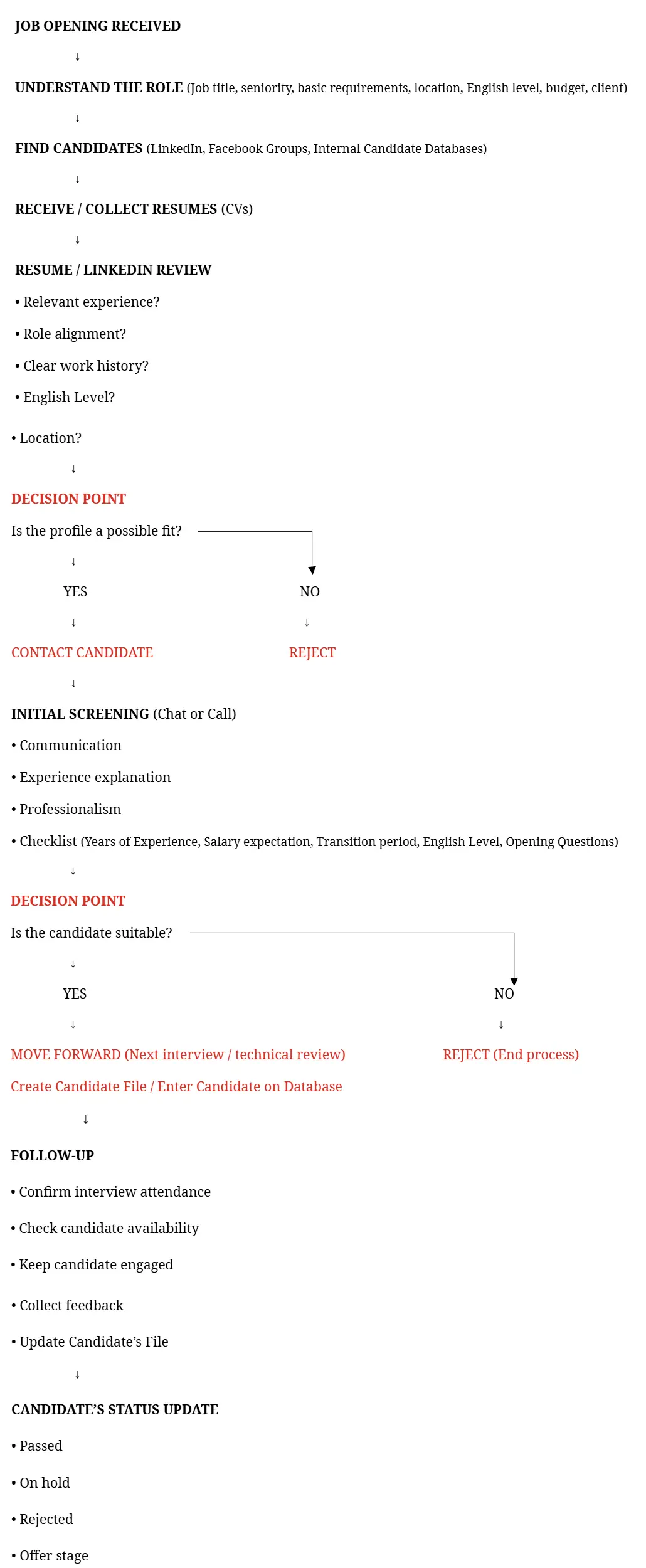
What Does a Recruiter Actually Do Day to Day?
-
Understand the Role
- Job title, seniority, requirements
- If you don’t understand the role, you cannot evaluate candidates
-
Find Candidates
- Search on LinkedIn
- Post in Facebook groups
- Review inbound messages
-
Review CVs / Resumes
- Relevant experience
- Role alignment (frontend, backend, fullstack)
- Job stability
- Clarity of information
-
Contact Candidates
- Send messages, answer questions, schedule conversations
- Communication should be professional, clear, respectful
-
Initial Screening Call or Chat
- Can the candidate explain their experience?
- Can they communicate clearly?
- Do they seem honest and professional?
- Do they understand the role?
-
Decide: Move Forward or Not
- ✅ Move forward
- ❌ Do not continue
-
Organize Information
- Candidate names, resumes, status
- Organization is key
What Makes a Good Recruiter?
A good recruiter:
- Pays attention to details
- Asks questions
- Is comfortable saying “no”
- Communicates clearly
- Protects the company’s reputation
Recruiter Flow Chart